A 2d20 Voluntary Non-binary Resolution Thing
I was reading through some solo games and I came across this mechanic from a Mork Borg game called Ronin: Tales of the Masterless.
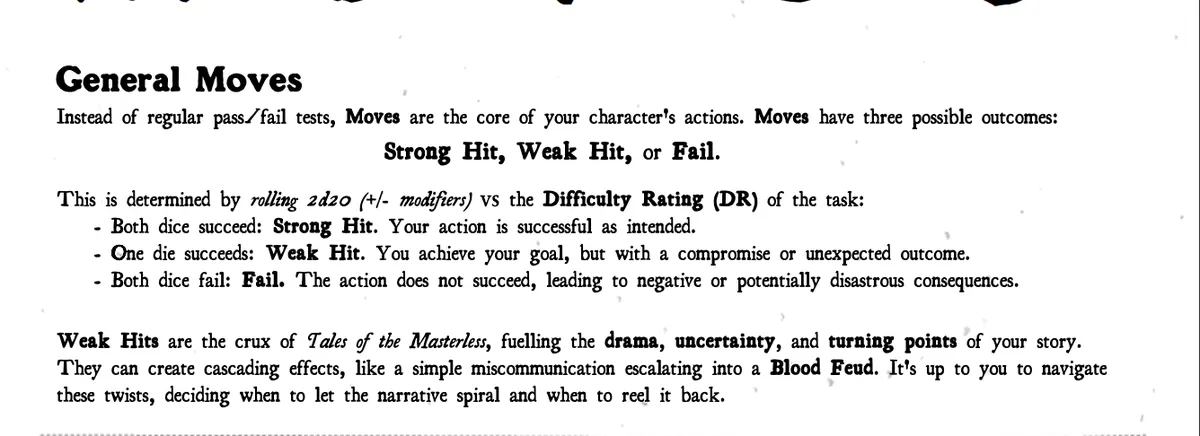
Now, I’m pretty sure this game took the idea from another Mork Borg solo game called Solitary Defilement, and that that game took the idea from Ironsworn which works in a similar but very different way. I’m sure the chain of inspirations goes back even further, but I’m going to add on to it because this mechanic feels like it would work pretty well in a d20 roll-under game for non-solo play. The rest of this post is a quickly thrown together draft.
The major goal here is to give players the ability to decide when and how to take complications to a roll, much like in this post by Mindstorm Press. I think making complications an active choice that players make in order to have better odds at succeeding a goal is rad.
2d20 non-binary Voluntary Roll-Under Resolution Thing
Note: I’m using the same definitions of Strong and Weak hit as the image above.
Core Shenanigans
Players have two options whenever rolling for any check, after everyone is on the same page about the consequences of failure or success.
- Roll 1d20.
- Roll 2d20 and decide on a complication for a weak hit.
The first option is your standard, binary roll. Any success on it will be considered a strong hit. This option has less overall chance of success, but a much better chance of succeeding without consequences.
The second option provides more nuance. The player and the GM should come to an agreement on what an appropriate complication could be. I haven’t come up with a definitive list of categories, but I think starting with the aforementioned post by Mind Press is a good idea, which they borrow from Schema:
Affliction, Alteration, Delay, Displacement, Expense, Indiscretion, Injury, and Mayhem.
The kind of consequence isn’t as important as the potential impact of the consequence. It should be both severe and relevant enough that the player has to really think about whether or not succeeding is important enough to risk further challenges. It also should be lead to interesting play. Furthermore, a GM should always have the ability to veto a 2d20 roll if an agreement can’t be reached on a suitable complication.
The target number matters a lot here as well. As an ability score (which most roll-under OSR games use)increases, the odds of the 2d20 roll being a strong success go up. One probably wants more flat and stable ability scores for this in most cases.
Also, this is meant as a player facing option: you can do it for monsters, but I don’t think it’s as interesting.
A Quickly Wrought Example
Tooth the Gorilla Warrior is attempting to swing across a bottomless chasm, which the GM has ruled to be dexterity check. While Tooth is confident in his impressive abilities, his player Vaughn is a bit more hesitant as he looks at the 8 on his character sheet, unfortunately next to the word ‘dexterity’. The GM has already set the stakes. If Tooth succeeds, he’s a happy gorilla on the other side of the chasm. If he fails, he finds himself in gorilla hell.
Vaughn decides that he’d rather have a better chance of succeeding than letting Tooth be done in by his ego. After some quick deliberation, it’s decided that he will roll 2d20. On a weak hit, Tooth will cross the chasm… 20 feet lower than where he wanted. He’ll also take 1d6 damage as a booboo.
With everything in order, Vaughn rolls his dice.
Some other unorganized ideas
- Critical successes and critical fails can probably work in the same way as the game we’re bolting this system onto, but with one change; for 2d20 rolls, both dice must both be a success for a critical success or failures for a critical failure.
- If your system crits on 1 and you have a target of 10, one die must be a 1 and the other at most a 10 for a critical hit to occur.
- Likewise, if critical fails happen on natural 20s, you would have to roll a 20 and a number above 10 for the roll to critically fail.
- Like strong hits, with this method a more skilled character has a higher chance of critical. I like that!
- Opposed checks can work as they normally would. Take whatever the best roll of the 2 is.
- Be hesitant with using advantage or disadvantage when using this system. You could, but I think there’s more challenges to it than it’s worth. Instead, I would just default back to the good ol’ days of flat modifiers. Maybe a +2/-2 for normal instances where advantage or disadvantage come into play, which should make 2d20 more appealing.
I’m going to try and find some way of testing this soon, though unfortunately my only game as a GM currently is a sporadic Nimble game. After some experience and feedback, I’ll try and get a post up about my findings. Cya Cya!